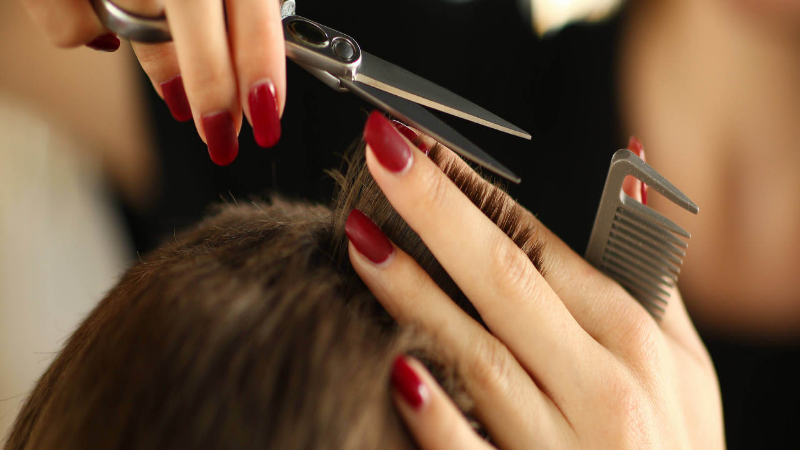
Hair that looks less full does not always mean the same thing is happening. In some cases, the issue is breakage along the hair shaft. In others, there may be a true reduction in the amount of hair growing from the scalp.
Understanding that difference matters because hair repair treatment and hair restoration solutions are designed to address different concerns. For women in Scottsdale, AZ, knowing what to look for can make conversations with a salon more productive and help set realistic expectations.
What Does Hair Breakage Usually Look Like?
Breakage happens when strands snap somewhere along the hair shaft rather than falling naturally from the root.
One of the clearest signs is uneven length. Someone may notice short pieces around the hairline, crown, or ends even though they have not recently cut those sections. The hair may also appear frizzy, rough, or thinner through the mid-lengths and ends.
Breakage can be associated with repeated heat styling, chemical processing, aggressive brushing, tight hairstyles, or a combination of several factors.
Unlike true thinning, the number of follicles producing hair may not have changed. The hair simply is not remaining intact long enough to maintain its previous length and density.
What Does Actual Hair Thinning Look Like?
Thinning usually refers to reduced density at the scalp.
Instead of noticing random short pieces, a person may see more scalp through the hair, a wider part, less volume near the crown, or a smaller ponytail circumference.
The hairline may also appear less dense over time.
Because true thinning involves changes in the amount or thickness of hair growing from the scalp, it is different from breakage even though both can make the overall hairstyle look less full.
This distinction is especially important when considering hair restoration for women, since cosmetic and salon-based options may focus on improving the appearance, strength, and manageability of the existing hair rather than changing follicle count.
Can Someone Have Both Breakage and Thinning?
Yes. The two concerns can occur at the same time.
For example, someone may naturally have lower density near the crown while also dealing with breakage through the ends from repeated coloring or heat styling.
That combination can make the hair appear much thinner overall because there is less density near the scalp and less retained length through the lower sections.
This is why a visual assessment should look at the entire head rather than focusing on one area.
Why Does the Location of Short Hair Matter?
Short hairs can provide useful clues.
If the shorter pieces appear mainly around areas exposed to tension, heat, or chemical processing, breakage may be more likely. If short hairs are evenly distributed and appear to be new growth, they may simply be part of the normal growth cycle.
The ends can also reveal information. Hair with visible splitting, roughness, or repeated snapping often points toward structural damage.
A hair repair treatment may help improve manageability and reduce further stress, but it cannot permanently fuse a strand that has already broken. Managing damaged hair often involves a combination of conditioning, trimming, gentler styling, and reducing repeated chemical stress.
Why Can Chemical Services Make Breakage More Noticeable?
Coloring, lightening, perming, and straightening all change the structure of the hair to some degree.
When these services overlap repeatedly, certain areas may become more fragile than others. The ends usually have the longest chemical history, which is why they may begin breaking before newer growth does.
This can create the appearance that the hair is “not growing,” when in reality it may be growing normally at the scalp but breaking before the length becomes noticeable.
Hair restoration solutions for this type of concern often focus on preserving the hair that is already present and improving its overall condition.
Can Hair Texture Make Thinning Harder to Recognize?
Yes.
Curly, wavy, or highly textured hair can naturally create more visual volume, which may make early density changes less obvious. Straight or fine hair may reveal scalp changes sooner because the strands lie closer together.
Styling habits can also influence perception. Voluminous blowouts, curls, or extensions can temporarily make hair look fuller, while sleek styles may make lower density more visible.
This is another reason visual fullness alone does not always reveal the underlying issue.
What Does Non-Surgical Hair Restoration Mean in a Salon Setting?
Non surgical hair restoration can refer to cosmetic approaches that improve the appearance of fullness without surgical procedures.
Depending on the situation, that may involve strengthening treatments, strategic cutting, extensions, toppers, or other methods designed to support the look and condition of existing hair.
The best hair restoration approach depends on the actual cause of the concern. Hair that is breaking needs a different plan from hair that is truly thinning at the scalp.
A salon consultation can help identify whether the priority is improving hair integrity, adding visual density, or both.
When Should Someone Look Beyond Salon Treatments?
If hair density changes suddenly, progresses quickly, or is accompanied by scalp symptoms, it may be appropriate to speak with a licensed healthcare provider.
Salon services can support appearance, styling, and the condition of the hair shaft, but they do not diagnose medical causes of hair loss.
For women in Scottsdale, AZ, separating breakage from thinning is an important first step. Once the pattern is clearer, hair restoration solutions can be chosen based on the actual concern rather than simply treating all forms of reduced fullness the same way.